Inside a Recording Studio Session
Creating an arrangement in the studio is not just “send me a song idea and come back later.” At least, that is not the way I like to work. In my studio, the arrangement is born together with the artist, in front of the artist, with the artist involved in every important decision.
At Ronter Sound Recording Studio Philadelphia, this kind of work starts with the author, the song idea, the emotional direction, the references, the first rough image of the future track — and then we sit together and build the arrangement step by step.
Not from some abstract producer arrogance. Not from “I know better, sit silently.” No. The artist is the author. The artist has the main word. My job is to help the song become real.
The Beginning
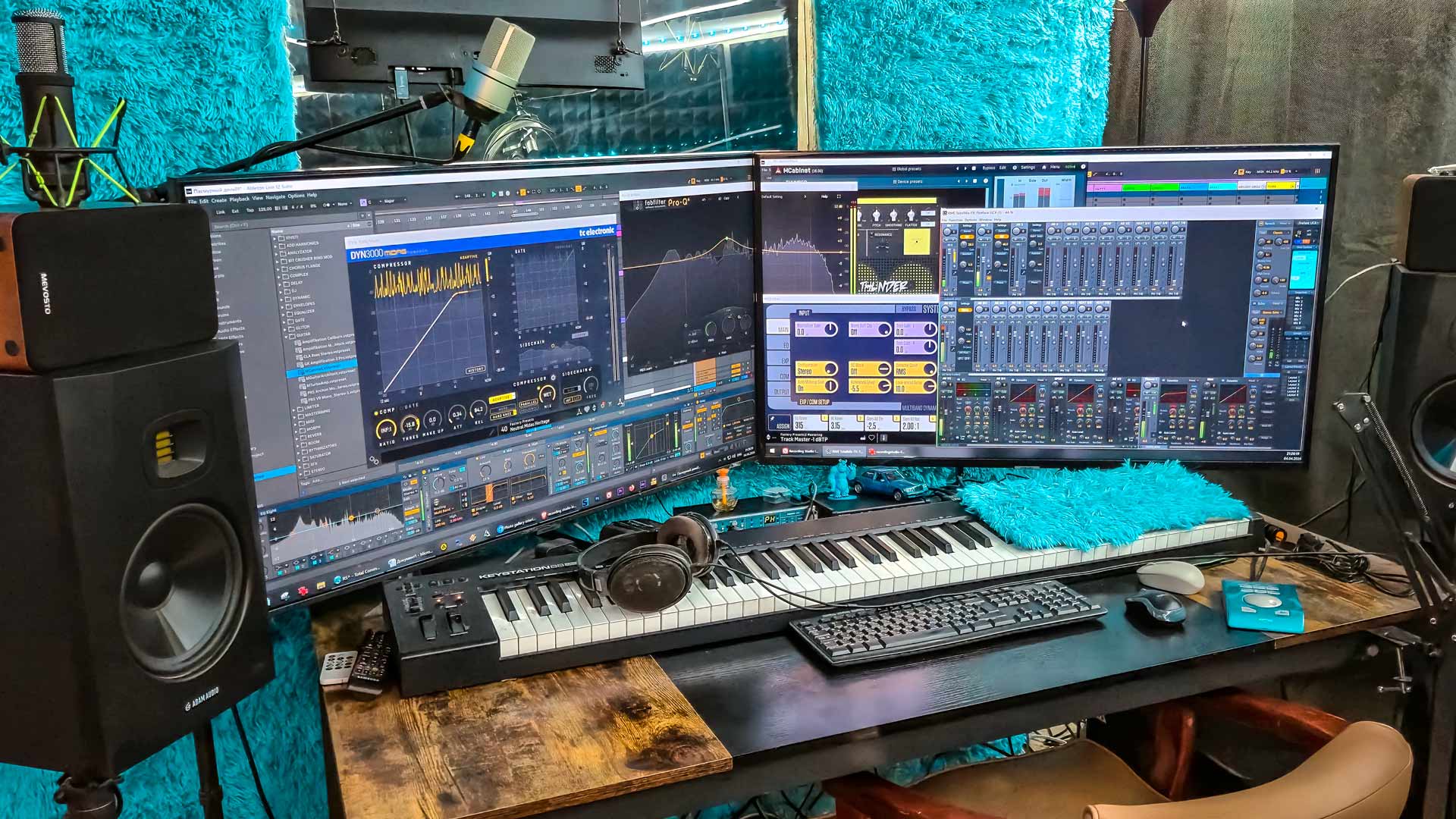
Work on an arrangement begins with a conversation with the author, with the artist.
The person comes to my studio, we sit down, and they tell me what kind of track they imagine. Not always in exact musical language. Very often not in musical language at all. And that is completely normal.
They may say: I want the song to have this kind of energy. I want it to be in this style. I want it to carry this emotional charge. I want it to feel sad, or aggressive, or intimate, or danceable, or cinematic, or bright, or heavy, or more minimal.
This is already material. Not notes yet. Not drums yet. Not bass yet. But it is already the beginning of the future arrangement.
A song does not start only when someone presses keys on a keyboard. Sometimes it starts earlier — when the author finally says out loud what the song should become.
References
Usually I ask for a reference.
Not because we are going to copy somebody else’s song. Copying is not the point. The reference is a language. It helps the artist show me what words cannot explain clearly yet.
The artist may say: I like the energy here. I like the drums here. I like the way the chorus opens here. I want the vocal to sit somewhere like this. I want the instrumental setup to feel something like this. I want the mixing direction to be roughly in this world.
And now we already have not just a vague dream, but an image.
We start to see the shape of the future track. We understand approximately where we are going. What kind of sound. What kind of rhythm. What kind of emotional temperature. What kind of density. What kind of musical behavior.
This is very important. Because if two people sit in the studio and both imagine completely different songs, then we are not producing music. We are wasting time politely.
Creative Direction
We ask each other questions.
What should this song do? Where should the energy grow? Should the verse be empty or full? Should the chorus explode or stay restrained? Should the drums be sharp or soft? Should the bass be aggressive or smooth? Should the piano be romantic or cold? Should the guitar be real, dirty, clean, wide, narrow, rhythmic, emotional?
This conversation is useful for me because I get acquainted with the future work.
But it is also extremely useful for the author.
Very often the author begins to understand their own song better during this conversation. They thought they wanted one thing, then suddenly they realize they want another. They never thought about some detail, and now that detail becomes important. They considered something obvious, but after we talk, it turns out it is not obvious at all.
This is why I like concrete conversation. It pushes the author into their own creativity. It makes the song mature in the head before it becomes sound.
First the track appears as an outline in our minds. Then we sit down and start making it real.
My Role
There is one thing I always explain honestly.
The artist has a creative idea. I have my skill, my musical experience, my hands, my ears, my taste, my internal world. And arrangement is not a mechanical copy machine.
Even if we discuss everything, even if the artist approves everything, there are still thousands of small decisions that are impossible to describe before they happen.
Some note appears under my fingers. Some chord movement feels right to me. Some rhythm seems more natural. Some timbre suddenly gives the song the right color. Some sound does not work, although on paper it should. Some very small musical turn changes the emotional face of the whole phrase.
This is subjective. Of course it is subjective.
If another arranger did the same idea, the arrangement would come out a little different. Maybe even very different. Because every musician carries their own relationship with music inside the work.
So yes, my creative vision will be present. Not instead of the artist’s vision, but together with it. There is no way around this. That is what creative work is.
Studio Time
Since creative search can take an unpredictable amount of time, we agree on one simple principle: we work together in the studio, and studio work is hourly.
The payment is for the actual time spent.
Not more. Not less. Exactly as much time as we used.
This is my condition when working on a backing track or arrangement with the artist. Because nobody honest can always know in advance how long creative work will take. Sometimes the right solution appears quickly. Sometimes we need to search. Sometimes one sound immediately works. Sometimes we try five and reject all of them. Sometimes the song tells us the answer after ten minutes. Sometimes it fights us for two hours.
In some cases this can be a little more expensive than ordering some arrangement from somebody somewhere. In other cases it can be much cheaper, especially if another route involves a whole staff of musicians, live instrumentalists, separate recordings, and a larger production chain.
But the good thing is that the structure of the work is clear. We sit together. We work. Time is counted. The artist sees what is happening. The artist participates. The artist understands where the result is coming from.
In the Studio
Then we sit down in my studio and begin.
I have instruments. We can record live guitars. We can record piano or keyboard parts. I have a MIDI keyboard. We can use virtual instruments. We can build drums. We can search for samples. We can try different sounds, different textures, different approaches.
We start writing the arrangement part by part.
Drums. Bass. Keys. Guitar. Pads. Melodies. Counter-melodies. Transitions. Breaks. Intro. Verse. Chorus. Bridge. Ending.
Every timbre, every sound, every sample, every musical part is shown to the client and approved.
The artist listens and says: yes, this is it. Or no, this is not it. Or maybe this is close, but let us make it more alive. Or more minimal. Or darker. Or more energetic. Or softer. Or wider. Or less busy.
This is not a problem. This is the work.
No Music School Required
If the artist has no music education, that is not scary.
They do not need to explain everything with academic terms. They do not need to know the name of every chord. They do not need to know why a certain bass movement works with a certain drum pattern.
I show the part before we commit to it.
I may say: let us try this. Let us make the drums behave like this. Let us put this bass here. Let us play this piano phrase. Let us make this chorus open more. Let us make the verse thinner so the vocal has more room.
And the author listens not as a professor, but as the author.
Does it feel right? Does it fit the song? Does it match the emotion? Does it help the story? Does it make the chorus stronger? Does it create the correct atmosphere?
That is enough.
Music theory is useful. Of course it is useful. But the author’s reaction is also musical information. If the author says “I do not like this,” that matters. Then we search. We play. We change direction.
Building the Arrangement
This is how we build the track.
We search for the sound. We search for melodies. We search for timbres. We search for groove. We search for decisions.
How should the verse work?
How should the chorus work?
Should there be an instrumental break?
Should something happen before the chorus?
Should the drums disappear somewhere?
Should a live instrument be recorded?
Should the arrangement become more minimal, or does it need more movement?
We do not answer these questions theoretically. We answer them by making the song and listening.
That is the whole beauty of working together in the studio. The decision is not somewhere far away. The decision appears in front of the artist’s ears.
Participation
This model of arrangement work gives a lot to the musician, especially to a beginning songwriter or artist.
Because everything is created right before their eyes.
Maybe for the first time, they see the backstage kitchen of music production. How a track is built. What tools are used. How decisions are made. Why one sound works and another does not. Why a drum pattern changes the whole body of the song. Why bass is not just “low notes,” but movement and weight. Why a small transition can make the chorus feel more important.
The artist cannot remain passive.
I involve them constantly.
Here is this part. Listen. Do you approve it? Should we change something? Should it be more alive? More minimal? More aggressive? Softer? More open? More dry? More atmospheric?
They answer. They decide. They compare. They choose between options.
And this alone gives the artist a huge boost in development as a musician, songwriter, and producer.
Authorship
I always give the author the main role.
They approve. They reject. They ask for changes. They weigh different options. They decide what feels correct for their song.
Of course, I bring experience. I bring my ears. I bring skill. I bring musical solutions. I can suggest, warn, explain, show another version, say that something does not work, or that something works better than they think.
But the final word belongs to the author.
Because the song is not mine instead of theirs. The song is theirs, and I help it become stronger.
This is very important. In some studios the artist feels like they gave the song away and now someone else is doing something mysterious with it. I do not like that model. I want the artist to understand, participate, and feel that this music is being born with them, not without them.
After the Parts
When all the parts are written, when the structure is built, when the intro, verses, choruses, breaks, transitions, and ending exist, the work is still not just “done.”
Now we start making the arrangement behave like one piece of music.
We find balances. We search for the right effects. We listen for frequency relationships. We look for groove. We make sure instruments do not fight each other. We make sure the track moves and does not just lie there like a pile of correct sounds.
And all of this is still done with the author.
Because the arrangement was not made somewhere in isolation and handed over like a package. It was created together. Without the author’s participation, this process does not move in the same way.
Space for the Voice
While building the arrangement, we always remember one extremely important thing: there will be a voice here.
The arrangement is not created as a self-satisfied instrumental monster that has eaten all the space and left no room for the singer.
We leave space for the voice.
Space in the arrangement. Space in the frequencies. Space in the dynamics. Space in the stereo picture. Space in the musical logic.
Sometimes an instrument is the leader in the intro. Then it disappears or steps back, and the voice becomes the leading instrument. Sometimes a melody in the arrangement must not compete with the vocal melody. Sometimes a bright instrument needs to move away because exactly there, in that frequency area, the voice must sit.
This is not an afterthought. This is part of arrangement thinking from the beginning.
A good arrangement knows when to speak and when to shut up.
Complete Song
We are not writing background music for decoration.
We are creating a musical environment where the vocal will later become the main event.
The voice is also an instrument. Often the most important instrument. It carries the text, the story, the personal face of the artist, the emotional message.
So the arrangement must support the voice, not strangle it.
If everything plays all the time, if every instrument tries to be clever, if every bar is filled with little decorations, then where will the voice live? In the hallway? Under the carpet? Somewhere behind the synthesizer?
No. We make room.
We decide where the arrangement leads, where it supports, where it answers, where it creates pressure, where it opens, where it becomes minimal, and where it lets the artist stand in front.
Growth
For the artist, this process is not only about getting an arrangement.
It is also education. Very practical education. Not boring textbook education. Not “open page thirty-seven and learn what a dominant chord is.” Real education through making music.
The artist sees where notes come from. Why certain notes work. Why some melody is good and another is weak. How drums change energy. How bass gives weight. How a piano part can support a chorus. How a guitar can create rhythm. How a pad can create air. How changing one sound changes the whole emotional temperature of the track.
They see what happens when I move controls, change dynamics, adjust volume, change balance, place sound in space. They see that arrangement is not magic fog. It is decisions. Many decisions. Musical decisions.
And because they are not watching from far away, but participating, they grow much faster.
Maybe they still do not know notation after one session. Fine. Maybe they still cannot fully explain how melody is born. Also fine. But they participated. They saw it. They heard it happen. They became a little more professional.
Long-Term Development
One arrangement. Then another. Then another.
Track by track, the artist begins to understand more.
They start hearing structure. They start understanding why a chorus needs lift. They start noticing when the bass is not helping. They start feeling when drums are too busy. They start understanding why the voice needs room. They start making better decisions earlier.
This is how the person is carefully brought into the world of music creation.
Not by humiliating them with theory they do not yet know. Not by saying “you are not a musician, sit quietly.” No.
By involving them. By showing. By asking. By letting them decide. By letting them hear why one option works and another does not.
This process gives pleasure. It gives understanding. It gives confidence. And yes, over time it creates a better artist.
The Method
I like this method because the artist is not just ordering a product.
The artist is making music.
Yes, with my help. Yes, with my experience. Yes, with my instruments, my studio, my ears, my hands, my decisions, my taste. But the artist is there. The artist is involved. The artist approves. The artist grows into the song.
And then the arrangement belongs to them in a much deeper way.
Not just because they paid for it.
Because they watched it being born and participated in its birth.
This is very different from ordering a faceless beat from somewhere, receiving a file, and trying to convince yourself that it is truly your musical world.
Here the song is created with you. Around you. For your voice. For your story. For your emotional direction.
Create Your Arrangement
If you have a song idea, a melody, lyrics, a voice memo, a rough demo, a mood, a reference, or just a feeling of what the track should become, we can work with it.
We will sit together in the studio, talk through the idea, listen to references, build the arrangement part by part, choose sounds, write musical parts, shape the structure, leave room for the vocal, and bring the song toward a real professional track.
You do not need to know everything. You do not need to be a trained arranger. You do not need to speak academic music language.
You need an idea, honesty, patience, and willingness to participate.
I will help you translate your creative feeling into music.
Come to the studio. We will work carefully, musically, and together — and we will make your song real.