Instrument Recording Philadelphia
Guitar recording is not mainly about finding some magical tone, legendary amp, sacred pedal, or secret plugin chain. Most of the time the real question is much simpler and much more brutal: can the guitarist actually play the part cleanly, tightly, rhythmically, and with control?
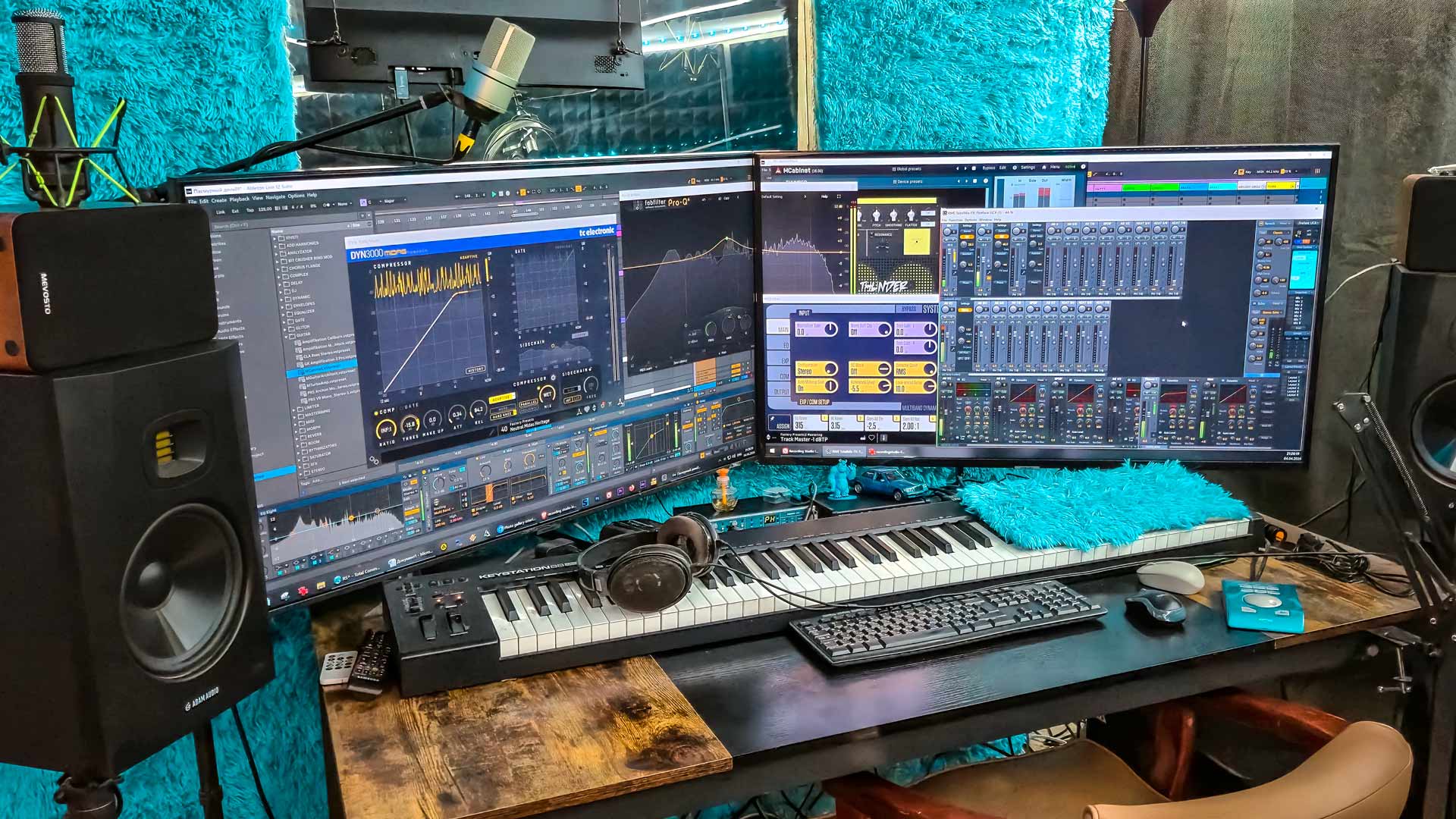
At Ronter Sound Recording Studio Philadelphia, I record guitar with a modern production mindset. The goal is not to worship gear. The goal is to capture strong raw material and build the guitar sound that actually works inside the song.
Guitar tone does not exist by itself. It exists inside the track. A sound that feels huge in the room can become useless mud in the mix. A sound that feels modest alone can sit perfectly once bass, drums, vocal, arrangement, and space are around it.
The Real Problem
With vocals, psychology is often the main monster. With musical instruments, and especially guitar, the main monster is rhythm, clarity, and control.
If it is a solo guitar part, some rhythmic looseness may hide more easily. But when there are layers, doubles, bass, drums, or several guitar parts working together, every small rhythmic mistake starts making the whole production sound cheaper.
Then the engineer has two choices: rewrite the part or start suffering with editing. And yes, usually it is me suffering later, moving things into rhythm because the guitarist underestimated how much microtiming matters.
Gear can be adjusted. Sound can be shaped. A not-perfect guitar tone can be fixed, improved, colored, replaced, reamped, modeled, processed.
But weak playing skills are much harder to hide.
The Biggest Guitarist Mistake
One of the biggest problems in guitar culture is that many guitarists think about the guitar before thinking about the song.
They start asking about gain, palm mute, cabinets, pedals, plugins, pickups, and all those technical details before answering the main question: what is the guitar actually doing in this song?
Is it the lead instrument? Is it counterpoint? Is it melodic background? Is it rhythm guitar with a harmonic function? Is it just distortion color to give the track rock energy? Until that function is clear, all those tone conversations are often just decorative panic.
If I personally were building a song from zero, I would first decide the function of the guitar. Only after that would I begin writing the actual notes, chords, voicings, rhythm, and interaction with other instruments.
And only after that comes recording: playing the planned part, trying variations, maybe catching something accidental that works better, and then shaping the sound during mixing.
But asking “what gain should I use?” or “what palm mute should I do?” at the very end often means you already skipped the real composition work and are now trying to save laziness with tone.
Usually at that point you do not discover genius. You just dig up clichés and generic guitar habits.
Rhythm First
Guitarists often talk about tone as if tone is the holy center of the universe.
But in recording, rhythm and rhythmic accents are more important than almost everything else.
Bad tone may sound unpleasant. Bad timing makes the whole song feel amateur.
Tight rhythm guitars sound expensive because they create the feeling that the whole arrangement is locked, confident, and moving as one body. Loose guitars make even a good arrangement feel cheap, weak, and unfinished.
And the most painful thing is that many musicians do not hear their own microtiming problems clearly. They feel the energy of playing, they feel the physical excitement, they feel the instrument in their hands — but the recording does not care about their feelings. The recording shows where the notes actually landed.
The Hidden Truth
Guitarists endlessly discuss wood, pickups, amps, plugins, cabinets, pedals, strings, cables, and mystical tone theories.
Meanwhile the real guitar player is often the right hand.
The right hand creates attack, rhythmic confidence, accents, muting, energy, groove, clarity, palm mute character, and the basic quality of sound extraction.
Weak right hand control instantly creates mud, loose rhythm, random accents, weak palm mutes, unfocused tone, and that unpleasant feeling that the part is technically there but somehow not really owned by the musician.
Strong guitar recording is very often simply strong sound extraction. The strings must be controlled. The attack must be intentional. The rhythm must feel owned.
You hear this immediately, even before any real tone shaping starts.
Why Recordings Sound Cheap
Usually amateur guitar recordings are not destroyed by “bad plugins.”
They are destroyed by weak rhythm, unclear accents, random timing, lazy muting, uncertain attack, chaotic extra strings ringing, vague arrangement thinking, and parts that do not really know why they exist in the song.
Sometimes every note individually sounds “fine.” But after eight bars the entire thing becomes repetitive, flat, predictable, emotionally dead.
This is especially common when every riff uses the same accents, every song has the same guitar behavior, and every section repeats the same rhythmic character.
Then the recording starts sounding not like music, but like somebody practicing patterns.
Tone Is in the Hands
Yes, “tone is in the fingers” is partly true. Not in some mystical forum nonsense way. In a very practical way.
You hear a good guitarist immediately: in the attack, in the confidence, in the control, in the way the notes sit, in the way the right hand extracts sound from the strings.
Sometimes a guitarist starts playing and you immediately feel: this is the owner of the guitar. The instrument is not dragging him behind. He controls it.
And sometimes there is expensive tone, expensive guitar, expensive dreams, expensive everything — but the part itself is vague, uncertain, and weak.
That is not a tone problem. That is hands.
Gear Worship
Guitarists are often obsessed with gear. And I understand why. Many of them are concert musicians. They need their sound in real time. They build pedalboards, choose pickups, love amps, tubes, cabinets, preamps, cables, and all that beautiful guitar religion.
But in my studio, for the way I work, I do not need most of that.
I follow a modern digital recording approach: first capture the cleanest, most flexible raw material, then build the sound later according to the arrangement.
This is where I strongly disagree with many old-school guitarists. They believe the sound must already be finished before recording. I believe the material must first be recorded well, and then the sound should be shaped in production.
Because once the sound is baked into the recording with pedals, amps, cabinets, and processing, creative options become narrower. Sometimes much narrower.
Modern Guitar Recording
I usually record guitar in line, as a clean DI signal.
Why?
Control.
A clean untouched source gives maximum flexibility. I can shape the sound later, change the amp model, change the cabinet, change the drive, change the color, change the space, change the whole role of the guitar in the arrangement.
Most importantly, I can always go back.
That rollback possibility is extremely important. If the guitar was recorded through a fully committed chain and later the sound does not work in the mix, congratulations, now we are stuck with somebody’s beautiful mistake.
With DI, the beginning of the chain remains untouched. That gives me freedom. And in production, freedom is not a luxury. It is survival.
Old School vs Modern Recording
There are different schools of guitar recording.
The old classic school first builds “that exact sound” with an amp, cabinet, microphones, pedals, processors, and maybe a mixing console. Then this already shaped sound is recorded and used in the mix with minimal correction, because honestly, there is not much left to correct. The sound is already baked.
The more advanced classic school records the guitar DI and then reamps it later through real amps and cabinets. That already gives the engineer a second chance. If the sound did not work, you can reamp again. There is a right to make a mistake, although every redo is still work.
My preferred modern school is different: record the most raw, clean, honest DI signal directly from the guitar, then build the sound in the DAW in real time. I can change it instantly, automate it, parallel-process it, reshape it, and return to the beginning if needed.
For me, that is almost all advantages: flexibility, control, cleaner workflow, no unnecessary analog noise, no medieval relics pretending to be mandatory magic.
That is why my studio has honest converters and preamps, but not a museum of guitar cabinets, rack units, pedal chains, and “tube magic of the old school.”
Amp Sims vs Real Amps
I know some guitarists will suffer reading this, but I will say it directly: modern amp sims, plugins, modelers, and digital tools are already extremely strong.
In many cases they do not lose to real amps at all. And even if somewhere they do lose in some tiny sacred detail that guitar forum priests will argue about for 40 pages — in the mix almost nobody will hear that difference.
What people WILL hear is bad timing, weak attack, messy muting, unstable rhythm, dirty accidental strings, and insecure playing.
I personally love tube gear too. Tubes are aesthetic. They are tactile. They create ceremony. Beautiful lights, knobs, heat, ritual — yes, I understand the pleasure.
But ceremony is not the same as production necessity.
A Strange Guitarist Problem
I once met the kind of situation where the guitarist wanted only one very specific pre-made sound. Without that exact sound already turned on, he could not really play comfortably.
And here the question appears by itself:
what kind of guitarist is that, if he can only play inside one specific sound?
Of course sound affects feel. I am not pretending it does not. But if the entire performance collapses without one exact preset, then maybe the preset is not “your tone.” Maybe it is a crutch.
A mature guitarist should be able to give the needed part. The sound can be built. The part must be played.
Distortion Lies
Distortion is beautiful when it is intentional and controlled.
But distortion also hides problems. It smears details, covers weak articulation, masks messy hands, and lets a guitarist feel more powerful than the actual playing really is.
That is why recording clean DI can be unpleasant for guitarists at first. Suddenly every mistake becomes audible. Suddenly expression must come from the hands, not from a huge wall of gain.
For many guitarists this is an uncomfortable discovery.
But the final result becomes much more controlled, technical, and mix-ready after processing, because the performance itself was forced to become cleaner.
Heavy Guitar Problems
Many beginners think “more gain” or “more low end” automatically means heavier guitars.
But heavy guitars are much more dangerous than that. Distorted guitars already contain huge amounts of harmonic information and density. Add low tuning, seven or eight strings, too much mid-bass, weak arrangement, and unstable rhythm — and suddenly the whole production collapses into undefined mud.
In the low-frequency area you may already have the kick drum, bass guitar, floor toms in breaks, and then guitars trying to invade the same space with seventh or eighth strings. This is a minefield. Do not go there unless you understand exactly what you are doing.
Sometimes a “huge” guitar tone becomes small in the mix because it conflicts with everything else. Only the frequencies that survived the fight remain, and sometimes what survives is simply garbage.
Heavy sound is not only guitar tone. Drums matter enormously. Rhythm matters. Bass matters. Arrangement matters. The whole rhythmic grid of the song shapes how heavy the guitars feel.
Guitar vs Bass
Many guitarists want more low end because there is energy there. I understand the temptation. Mid-bass feels powerful. It makes the guitar feel bigger alone.
But this strategy is dangerous.
The guitar should not simply replace the bass. It has its own spectral role. If the guitar tries to become the bass, the arrangement starts fighting itself.
Yes, sometimes playing in unison with bass guitar can make the guitar feel heavier because the bass adds weight to the guitar line. But this requires discipline, because low-register conflicts sound awful very quickly. Even simple harmonic intervals in the bass register can become punishment for the ears.
A good guitar mix is not “more low end.” A good guitar mix is the guitar taking the right place.
Room Sound vs Mix Sound
“But it sounded great in the room.”
Yes. Maybe it did.
But room sound is a whole mountain of subjective impressions. You are standing there. You feel the amp, the air, the volume, the body vibration, the physical excitement of the instrument in that exact room.
The mix does not contain that room experience.
In the mix there is no “that magical room where you stood feeling powerful.” There is only the guitar part inside the arrangement.
That is a completely different reality.
A guitar sound must be judged by whether it works in the track, not whether it made the guitarist smile alone in the room.
Clean Guitar Terror
Distortion can hide many sins.
Clean guitar usually hides nothing.
Suddenly every detail becomes obvious: muting problems, weak attack, bad timing, finger noise, uneven dynamics, lazy articulation, random strings ringing.
Clean guitar is transparent. Honest. Merciless.
That is why many guitarists subconsciously hide inside distortion. Clean guitar forces the musician to confront the actual quality of their hands.
Acoustic Guitar
Acoustic guitar is very honest.
A good studio microphone will hear everything: finger noise, uneven dynamics, string squeaks, weak attack, unnecessary ringing strings, breathing, posture, and every little imperfection of sound extraction.
But this is not automatically bad.
A human being is an imperfect sound extractor. That is normal. That is how it should be. A completely perfect acoustic guitar often immediately starts sounding like a synthetic instrument.
The main problem in acoustic guitar recording is usually not tiny human imperfection. The real problem is lack of expression and dynamics.
Beautiful acoustic guitar is not dead-even. It breathes.
Double Tracking
A copied guitar track is not real double tracking. A perfect copy creates phase sameness, and you hear that dead artificial constancy.
Real double tracking means playing the part again.
But here is the brutal part: two badly played tracks are not automatically wider or better. If they are rhythmically fighting each other, they sound worse than one track.
But if the difference is in tone, micro-nuance, human variation, and performance life — while the rhythm remains controlled — then the two tracks can sound much better together.
Tight double tracking is difficult because it demands both discipline and humanity. Too loose becomes messy. Too identical becomes dead.
Concert Reality vs Studio Reality
On stage, volume hides details. Distortion hides articulation. Crowd energy masks imperfections. The physical atmosphere carries emotion.
Recording studios are much more ruthless.
The studio freezes the performance forever and allows repeated listening.
Suddenly timing becomes exposed, weak muting becomes exposed, lazy rhythm becomes exposed, and vague articulation becomes exposed.
Many guitarists feel like gods on stage, especially when everything is loud and distorted and nobody can really hear the small details.
Then the studio recording calmly and honestly explains: no, here are the actual problems.
The Studio Mirror
Home recording often does not give a guitarist expert feedback. It does not always show whether the part is actually good, whether the performance is clean enough, whether the rhythm is tight enough, or whether the guitar belongs in the arrangement at all.
The studio exposes lack of performance skill quickly.
And that is not an insult. That is useful.
After a serious guitar recording session, the musician should understand two things: what was strong enough to repeat, and what was weak enough to practice.
That is how growth works. Not through worshiping another pedal. Through hearing reality and improving the hands.
Virtuosity Without Music
Modern guitar culture often turns music into athletic competition.
Endless shredding. Endless “look how fast I can play.” Endless technical flexing.
Technical ability is valuable. Of course it is.
But speed for the sake of speed is not automatically musical.
Sometimes musicians become obsessed with making every single note technically perfect by itself, instead of thinking about phrases, movement, emotion, dialogue between instruments, and the musical architecture of the track.
A note by itself is rarely musical. Musicality usually appears from context, arrangement, movement, expectation, and emotional direction.
Record Guitar in Philadelphia
If you want to record guitar seriously, come with the strongest playing you can give. The tone can be shaped. The sound can be built. The role of the guitar can be found inside the arrangement.
But the part must be played.
Good guitar recording is not gear worship. It is rhythm, control, hands, taste, and production thinking.
This page is part of the Instrument Recording Philadelphia guide.