Instrument Recording Philadelphia
Piano is not just one more instrument. Piano is almost the whole orchestra trapped under ten fingers. Melody, rhythm, bass, harmony, pads, attacks, dissonance, arpeggios, blues, jazz, pop, disco, romantic sadness, cinematic pressure — everything can live there.
At Ronter Sound Recording Studio Philadelphia, I record piano and keyboard parts with a modern production mindset. Not with fake studio snobbery. Not with the idea that music becomes serious only because a giant grand piano is standing in the room. Music does not care about furniture. Music cares whether there is thought, rhythm, emotion, and control.
Piano recording is not only about the piano sound. It is about the part. The hands. The dynamics. The role inside the song. The musical intelligence of the person playing it. And the simplest test of all: do I want to keep listening?
The Instrument
I love piano because it is the most universal, self-sufficient, and multi-sided instrument.
It can be the lead instrument like a saxophone. It can build rhythmic patterns like a guitar. It can hold the bass like a bass guitar. It can carry chords, harmony, pads, attacks, counter-melodies, little answers, wide emotional backgrounds, and sharp rhythmic accents.
It can play a sus2 or sus4 chord and make dissonance beautiful. It can play arpeggios and make time flow. It can create ten-finger polyphony. It can whisper blues. It can jump into jazz improvisation and suddenly the whole room becomes smarter.
That is why piano is my trusted plan B in arrangement. If I cannot find the right timbre for some musical function, piano can usually replace it and do the job. Not always because it is the most original choice. But because it works.
Sometimes I do not use piano only because I want variety in my songs. Not because piano would fail. Piano almost never fails.
The Player
My personal marker of a real pianist is simple. Can they play a difficult passage so the notes do not stick together into one lump?
Not “do they look inspired.” Not “did they study somewhere serious.” Not “can they make a dramatic face.” Can they play the passage and not lose the music on the way?
Every note has to arrive. The rhythm has to live. The phrase must not fall apart. The hands must not panic. The music must not become a pile of fingers.
Piano is brutal in this sense. It gives a musician huge power, but it also exposes chaos very quickly. When the playing is not collected, you hear it immediately. You may not know the theory, but the ear knows. The ear always knows.
Technology can help. MIDI can be cleaned. Notes can be moved. Velocity can be shaped. But if there is no musical control in the hands and no musical thought in the head, the production has to start saving what should have been played properly.
Composition vs Performance
When a piano recording sounds weak, first we need to understand where the weakness comes from.
If the piano part itself is badly written, if the melody has no taste, if the pattern is empty, if the harmony says nothing, if somebody just added piano because “piano means emotion” — that is the composer’s problem.
But if the part is good and the pianist cannot play it, that is already another problem. Then the music exists, but the hands cannot deliver it.
For a beginner pianist, as for any musician, it is better to play something simpler and do it well than to take a burden that is too heavy and collapse under it.
Music does not give medals for heroic failure. The listener does not care that the idea was difficult. The listener hears whether it worked.
Modern Piano Recording
Important thing: my studio does not have a real acoustic piano or grand piano in the room.
Would I like to have a beautiful studio grand piano? Of course. I love piano. I would be happy to have one. But a real studio-quality grand piano is not just “put a piano in the corner and feel important.”
A serious grand piano is very expensive. Very expensive. It needs space. It needs a larger room. That room has to work acoustically with the instrument. It needs maintenance, tuning, climate stability, and a whole different scale of studio.
And then all of that cost goes into the price of the studio. Even if you are not a pianist. Even if you came to record vocals. Even if you came to record rap. Even if you came for voiceover. You would still be paying for the grand piano standing somewhere in the building.
I chose another strategy.
Ronter Sound is a small, comfortable, working studio with friendly prices. A studio where most real musical tasks can be solved without turning every session into a payment for someone’s luxury object.
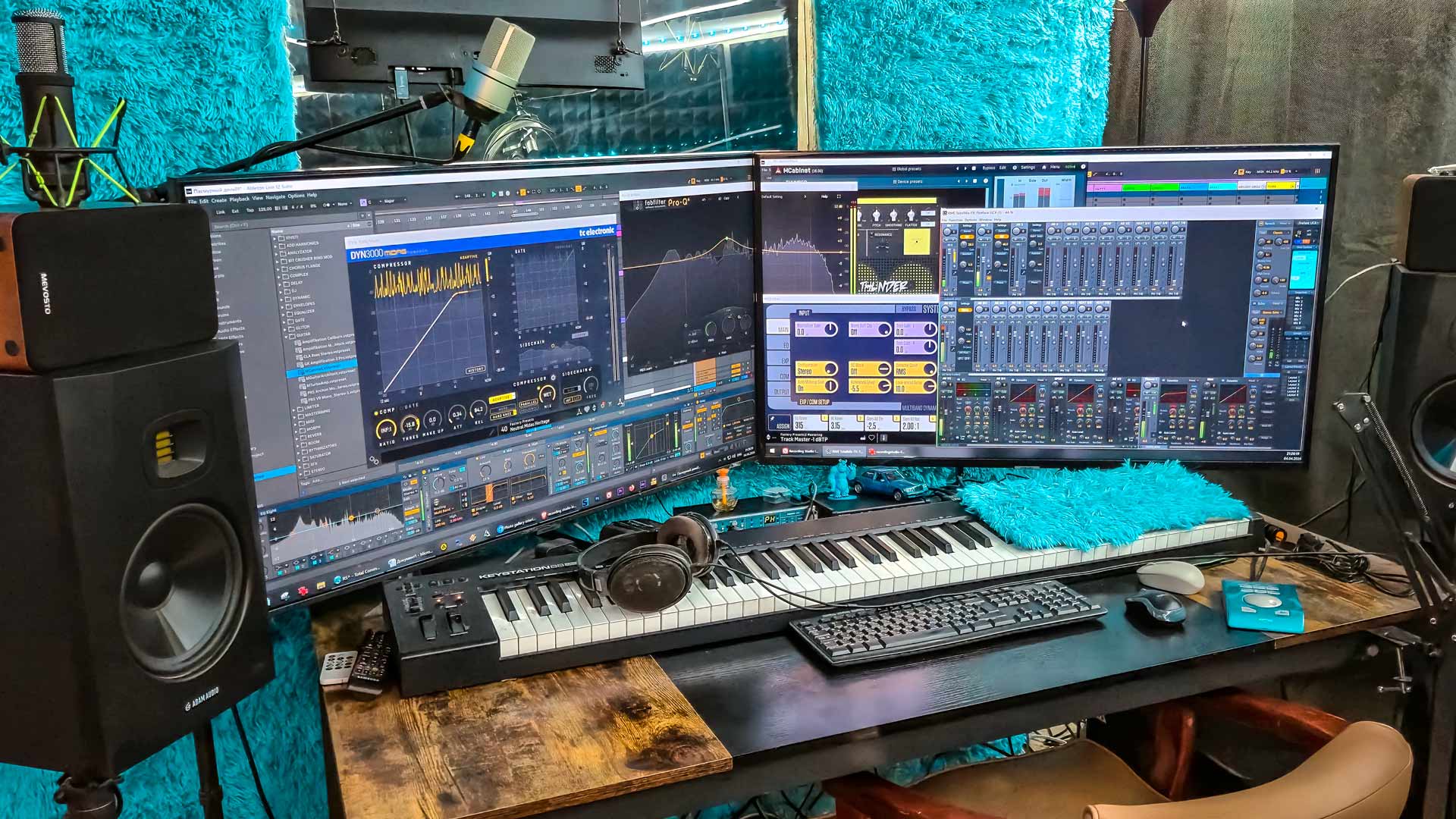
Instead of a real piano, I use full-size 88-key MIDI keyboard control and professional piano libraries. The keyboard becomes the interface between the pianist and different piano worlds: different instruments, different colors, different rooms, different recording systems, different characters.
This is not a religious war. Real piano is wonderful. MIDI piano is useful, flexible, modern, and often exactly what the song needs. The question is not what is “more holy.” The question is what works for the music.
Flexibility
With a real piano, you record one instrument in one room with one tuning, one mechanical condition, one acoustic character, one microphone setup, and one mood of that day.
Sometimes that is exactly what you need.
But modern production often needs flexibility. Maybe the song needs a darker piano. Maybe a bright pop piano. Maybe an intimate felt piano. Maybe something cinematic. Maybe something dry and honest. Maybe something wide and expensive. Maybe something small, close, and almost whispered.
With MIDI piano, we can choose the instrument after the performance. We can adjust velocity. We can correct notes. We can shape dynamics. We can change the piano sound if the vocal needs another space. We can make the piano serve the track instead of forcing the track to serve a sound recorded too early.
Flexibility is not weakness. In production, flexibility is often survival.
Arrangement Thinking
Piano can do so much that it creates a danger: people make it do everything at once.
Bass, chords, melody, rhythm, arpeggios, little emotional answers, dramatic fills, cinematic background, counterpoint, soft pads — piano can take all of it. But just because it can does not mean it should.
In a song, every instrument must have a function. Piano too.
Is it the emotional center? Is it supporting the vocal? Is it the harmonic bed? Is it the rhythm engine? Is it replacing guitar? Is it filling empty space because the arrangement has no imagination? These are different jobs.
If the role is clear, the piano part starts making sense. If the role is not clear, the piano becomes expensive wallpaper. Beautiful maybe. But still wallpaper.
Dynamics
One of the reasons piano is so alive is dynamics. Unlike an organ, piano reacts to the force of touch.
The same note can be shy, angry, romantic, broken, cold, noble, sarcastic, frightened, or desperate. The note did not change. The person changed.
This is why piano recording must preserve not only pitch and timing, but intention.
A piano part played with the same pressure from beginning to end becomes dead very quickly. Correct, maybe. But dead. Like somebody filled out a musical form correctly and forgot to live inside it.
Music is not a spreadsheet of correct notes. Music is pressure, release, breath, thought, movement, and feeling.
Human Feel
My opinion here is the same as with vocals, guitar, rap, or any other instrument: expression and emotion are more important than perfect mechanical playing.
But there must be a minimum professional level. Otherwise it becomes the happy expression of a child randomly banging on keys.
Maybe the child is sincere. Maybe the child is having a beautiful moment. Fine. But this is not yet a piano recording for a song. For a record, we need rhythm, form, clarity, control, and a musical idea.
I do not want to turn musicians into robots. In the age of AI, sterile perfection is not even impressive anymore. Soon small human imperfections will sound expensive. But imperfections are not the same as mistakes, laziness, and musical dirt.
The goal is simple: nothing should distract the ear from the music.
The Human Instrument
Any musical instrument is a continuation of the human nervous system.
First there is invisible work inside the person: thought, fear, memory, taste, impulse, courage, emotion, musical imagination. Nobody sees it. Then the hand touches the instrument, and this invisible thing becomes sound.
Piano is one of the clearest examples because it can express almost the whole musical body at once: bass, rhythm, harmony, melody, silence, attack, softness, pressure, and space.
A good pianist does not press keys. A good pianist turns inner movement into ordered sound.
That is why piano can feel so intimate. You are not only hearing notes. You are hearing the nervous system speak in music.
Piano Culture
Piano also has a funny and irritating side: trend culture.
At one time everyone discovered the dream-house piano style after Robert Miles’ “Children.” Piano appeared everywhere in the same two functions: harmonic arpeggio and emotional melody.
Then people rushed into cinematic piano, TV-series melodies, Interstellar-style patterns, TikTok sadness, and endless “deep” progressions where the sadness is supposed to become serious because the reverb is large.
I once watched this in Moscow almost like a social experiment.
There was a public piano on a pedestrian embankment where I often stopped while riding a bicycle. And I saw two things there constantly.
First: children who had no idea what music or an instrument is would run to the piano and just hit the keys for noise. Not play. Hit. And the parents stood nearby smiling like this was some wonderful sign of talent. “Oh, what an active child.” No. That is not talent. That is barbarism being encouraged by adults who should know better.
An instrument is not a toy for producing random public noise. It is not a trash can for energy that parents are too lazy to discipline.
Second: almost every person who could play even a little sat down and played one of the same two trendy melodies. Either something like Interstellar, or a theme from some fashionable youth series. They changed every five or ten minutes, not hearing the previous players, and still played the same thing again.
I sat there with friends, and after a while it became comedy. A new person sits down. We wait. Three seconds. Again the same melody. Everyone laughs. The pianist does not understand why.
I played blues improvisations, dixieland, Scott Joplin-style pieces — and almost nobody cared. People wanted the two cultural buttons they already recognized.
That is how trend culture works. Every generation gets its piano clichés. The problem is not that people love a melody. The problem is when they confuse a trend with their own musical language.
A Studio Story
I once recorded a cover band in the studio. They invited a keyboard player who had studied in a Russian music school for eight years, then four years in music college, then five more years in conservatory as a pianist.
Serious education. Serious background. No doubt he could play complicated classical pieces. Maybe Rachmaninoff. Maybe very impressive things. I am not mocking the technique.
But this was a cover band. They sent him the song a week before recording. He needed to prepare a keyboard part: understand the harmony, create a function for the keys, support the song, fill the right places, play the role the arrangement needed.
He could not do it.
Without written notes, he stopped being a musician and became a tape recorder for notation.
That was one of those moments when I thought: a musician is not simply somebody who can reproduce difficult notes. A musician is somebody who can make music.
Playing from the soul is not a decorative phrase. It means you understand what is happening, why this chord is here, what the part must do, what the song needs, and how to answer it with your hands.
If you can only play what is written, you may be very skilled. But music is bigger than playback.
Production Problems
Almost anything can kill piano. And almost the same thing can make it beautiful. Context decides.
Too much low-mid can turn piano into mud. Too much brightness can make it annoying. Too much pedal can blur harmony. Too little dynamics can make it flat. Too much playing can fight the vocal. Too little playing can leave the song empty.
A piano can be intimate and close. It can be wide and cinematic. It can be dry and honest. It can be distant and atmospheric. It can be aggressive like percussion or soft like breath.
There is no universal recipe. People who sell universal recipes usually sell confidence to people who do not yet hear enough.
The serious question is always the same: does the piano serve the song?
If it serves the song, even a simple part can be unforgettable. If it does not, even complicated playing becomes musical furniture.
For Artists
You can record piano or keyboard parts at Ronter Sound as part of a full song production, a vocal session, a cover, a singer-songwriter arrangement, a cinematic piece, a pop track, a rap beat, or a simple emotional idea that needs musical shape.
Sometimes piano is the foundation of the whole song. Sometimes it is only three notes in the right place. Sometimes it supports the vocal. Sometimes it creates the whole emotional world.
We can record the performance, choose the piano sound, adjust the arrangement, clean the part, edit MIDI if needed, shape dynamics, and make the piano sit inside the track instead of floating somewhere as decoration.
The goal is not to impress other pianists. The goal is to make the listener stay.
The Real Test
When I hear truly good piano playing, my highest praise is very simple: I continue listening.
Not checking the education. Not counting notes. Not admiring the difficulty. Not thinking “very professional.” I just listen. That is already enough.
There is a famous Soviet and Russian children’s TV show called “Good Night, Little Ones!” with a closing lullaby that millions of people know. On the surface, it is a very simple children’s song. Nothing that should shake the universe.
But the story I know is this: during the recording, they needed a keyboard player, and someone in the TV center corridors found not just any keyboard player, but the outstanding Soviet jazz pianist Boris Frumkin.
In one take, he gave himself freedom and played a completely fantastic unplanned thirteen-second piano solo. Thirteen seconds. In a children’s lullaby. And suddenly the take became a small cultural miracle for a whole country that not long before had treated jazz almost like an ideological disease.
That is piano at its best.
Not “look how many notes I know.” Not “look how serious I am.” Not “look how expensive the instrument is.” Just a living moment where music becomes bigger than the assignment.
If you are reading this and want the link to that solo, write me on WhatsApp. I will send it to you. Let it be our strange little interactive piano museum.
Advice
My advice is simple: enjoy playing. Play anything. Then make it harder. Then learn why it works.
Learn music theory. Not because theory makes you “academic.” Theory is language. At first it feels like boring grammar and alphabet. Then one day you realize you can read Shakespeare, even if slowly, even if syllable by syllable.
Piano gives you access to harmony, rhythm, melody, bass, form, emotion, and structure. It teaches you to think like an arranger, not only like a person pressing keys.
And if you are not perfect — good. Nobody asked you to be a machine.
But respect the music enough to prepare. Listen. Practice. Bring material that deserves to be recorded. Do not bring chaos and ask the studio to call it inspiration.
The song deserves better. The listener deserves better. And honestly, you deserve better too.
Instrument Recording Cluster
Piano is one of the great doors into music. Guitar is another. Voice is another. Rhythm, harmony, arrangement, and sound are others. But the goal is always the same: not just to produce sound, but to say something.